
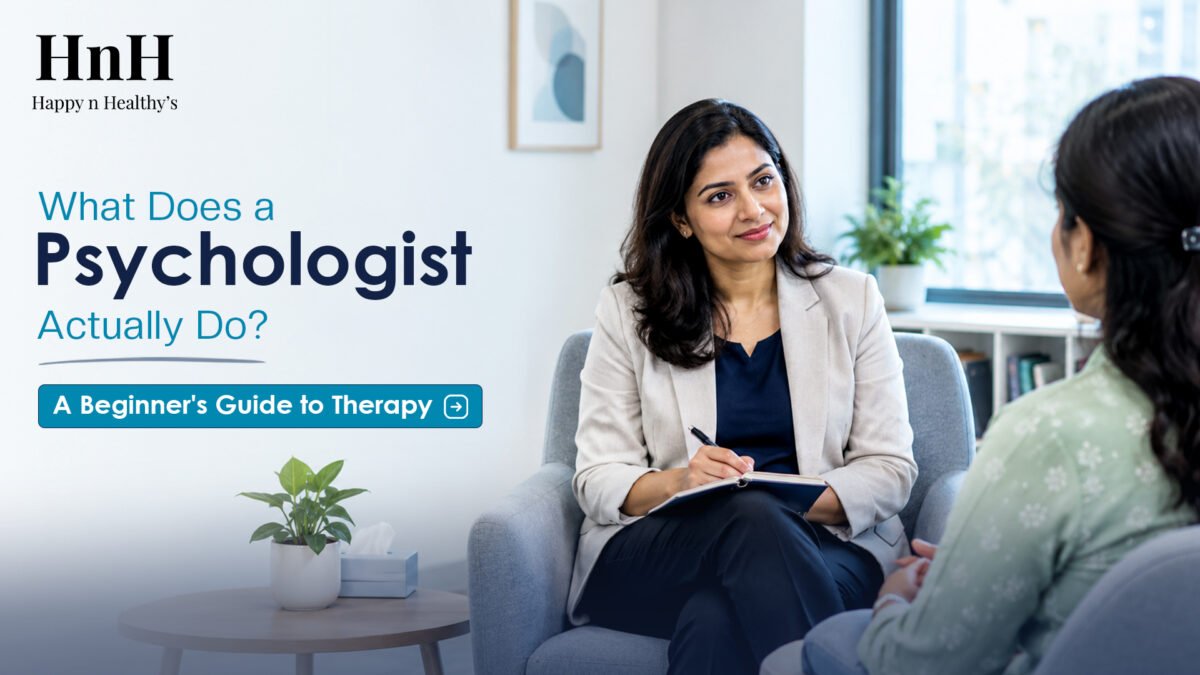

What Does a Psychologist Actually Do? A Beginner’s Guide to Therapy
A psychologist is a trained mental health professional who helps people understand their thoughts, feelings, and behaviour through talk-based sessions — not medication. If you’ve ever typed “psychologist near me” into Google at 1 a.m. and closed the tab before clicking anything, this guide is for you.
Most people who search for a psychologist never actually book one. Not because they don’t need help — because they don’t know what they’re walking into. What do you even say in the first session? Does it cost a fortune? Is it only for people with a “real” problem? Those questions are enough to make anyone close the tab.
None of them are hard to answer — they’re just rarely answered honestly.
So let’s actually answer them.
- How Therapy Works, in Plain Terms
A psychologist doesn’t hand you advice like a friend would over chai. They’re trained to listen for patterns — the thing you keep doing even when it doesn’t work, the thought that shows up every time you’re stressed, the reaction you can’t quite explain. Over a series of sessions, usually 45 to 50 minutes each, they help you see those patterns clearly enough to actually change them.
It’s closer to physiotherapy for your mind than it is to a chat with a wise relative. A physiotherapist doesn’t just tell you to “walk it off” — they assess what’s actually happening in your joint or muscle, then guide you through specific exercises. A psychologist does the same thing, except the muscle is the way you think.
Some sessions are structured, especially with approaches like CBT (Cognitive Behavioural Therapy), where you might track specific thoughts between sessions and bring them back to discuss. Others are more open-ended, especially early on, while the psychologist gets a full picture of what’s going on. Either way, nobody is diagnosing you off one conversation. Good therapy takes a few sessions before any real pattern becomes clear — which is worth knowing going in, so you don’t expect a fix by session two.
- Psychologist, Psychiatrist, or Counsellor — Who Do You Actually Need?
This is the single biggest confusion people walk in with, and it’s a fair one — the words sound almost interchangeable.
A psychologist is trained in talk therapy and psychological assessment. They don’t prescribe medication. A psychiatrist is a medical doctor who can prescribe medication and is usually the right call when symptoms are more severe — serious depression, bipolar disorder, conditions where brain chemistry is clearly part of the picture. At Happy n Healthys, for instance, Dr. Amitava Das sees patients in Kolkata who need that medical route, while the practice’s psychologists handle the talk-therapy side. A counsellor, meanwhile, usually has a narrower scope — think career guidance or relationship-specific counselling — and may or may not hold the same clinical training as a psychologist.
Here’s the part nobody tells you: you don’t have to figure out which one you need before you reach out. A decent practice will ask a few questions and point you in the right direction, even if that means a psychologist referring you onward to a psychiatrist after the first conversation. You’re not expected to self-diagnose your way into the correct appointment type.
- What Actually Happens in Your First Session
This is the part that keeps people from booking at all, so here’s the honest version.
Your first session is mostly talking. The psychologist will ask what brought you in, what’s been going on, maybe some background on your life and history — family, work, relationships, whatever’s relevant. You won’t be handed a clipboard of diagnostic questions like a hospital intake form. It’s a conversation, and a slow one, because trust takes a session or two to build.
You don’t need to arrive with a polished explanation of your problem. “I don’t really know why I’m here, I just feel off lately” is a completely normal way to start. Psychologists hear some version of that sentence constantly.
Sessions can happen face-to-face or online. If you’re in Kolkata, that might mean sitting across from someone in a clinic in Kasba or Behala. If you’re not — or just prefer not to travel — online counselling has become a genuinely equal option, not a fallback. Some practices, including Happy n Healthys, specifically offer online sessions in Bengali, which matters more than it sounds like it should. Explaining anxiety or grief in your second language, to someone who learned the clinical terms but not the emotional ones, is harder than most people admit.
- What a Psychologist Can Actually Help With
The image most people have is “serious mental illness only.” That’s wrong, and it’s the single biggest reason people wait years longer than they need to before booking a session.
Individual counselling covers the stuff that doesn’t have a dramatic label — low self-esteem, feeling stuck, a breakup that’s lingered too long, stress that’s started showing up in your body. Child psychology is its own track entirely: a psychologist working with an 8-year-old uses completely different tools than one working with an adult, often play-based or indirect, because kids don’t process a direct Q&A the way grown-ups do. Couple therapy isn’t reserved for marriages on the edge of ending — a lot of couples go in simply because they keep having the same argument on a loop and want someone neutral in the room. And career counselling, while it sounds more practical than emotional, often turns into exactly that once someone starts talking honestly about why a career decision feels impossible.
None of these require a crisis first. That’s the part worth sitting with for a second.
- Why People Put It Off Anyway
Even after all that, a lot of people still wait. Usually it’s one of three things: cost, the fear of being judged, or just not knowing where to start.
On cost — individual sessions at most Kolkata practices, Happy n Healthys included, typically start somewhere in the ₹1,000–1,500 range depending on the type of counselling, though it’s always worth confirming current pricing directly since it varies by psychologist and session type. That’s less than most people assume before they check.
On judgment — this one’s harder to argue away with facts, because the fear isn’t really about logic. But psychologists hear far stranger, far more “unacceptable” things than whatever you’re hesitating to say. Confidentiality isn’t a courtesy, either — it’s a professional and ethical requirement, with specific, narrow exceptions (like immediate risk to someone’s safety) that get explained upfront, not buried in fine print.
On not knowing where to start — that’s genuinely the easiest one to fix. Most practices, including ours, let you book a first consultation online without committing to anything beyond that single session.
- Frequently Asked Questions
Is therapy only for serious mental health problems? No. Most people who see a psychologist aren’t in crisis — they’re dealing with everyday stress, a specific decision, or a pattern they want to change before it becomes a bigger problem.
How many sessions will I need? It depends entirely on what you’re working through. Some people find clarity in 4–6 sessions; others continue for months. A psychologist should be able to give you a rough sense after your first couple of visits, not a fixed number upfront.
Can I switch psychologists if it doesn’t feel right? Yes, and you should. Fit matters more than most people expect — a psychologist who’s technically skilled but doesn’t feel right to talk to isn’t going to help much. Most practices won’t take it personally if you ask for someone else.
Is online counselling as effective as in-person? For most concerns, yes — research backs this up, and it’s become a standard option rather than a compromise. It’s particularly useful if travel, timing, or language (Bengali-language sessions, for example) is the thing standing between you and booking at all.
Do I need a referral to see a psychologist? No. Unlike some medical specialists, you can usually book directly with a psychologist without a doctor’s referral first.
What’s the actual difference between talking to a psychologist and talking to a close friend? A friend listens with love, but also with bias — they know you, which means they can’t be neutral. A psychologist has no stake in your decisions and is trained to notice patterns you can’t see from inside your own head. Friends are for support. A psychologist is for the parts support alone can’t fix.
- Where to Go From Here
If any part of this made you think “okay, that’s less intimidating than I thought” — that’s the point. The hardest part of therapy isn’t the therapy. It’s the first message or phone call.
If you’re in Kolkata or anywhere in India and have been putting this off, Happy n Healthys offers individual counselling, child psychology, couple therapy, and career counselling — face-to-face at their Kasba and Behala clinics, or online, including sessions in Bengali. Booking a first consultation doesn’t commit you to anything beyond that one conversation.
Latest Articles
-
 Ways in Which You Can Boost Your Mental Health
-
 Reasons Why You Should Seek Therapy
-
 How Couple Counselling Helps To Nurture Healthy Relations
-
 12 Common Marriage Problems Addressed in Couple Counseling
-
 Benefits of Child Counselling: Exploring Its Types, Importance, and Challenges
-
 Mental Illness in Children: Know the Signs